Zimbabwe's $8.5 billion mining year leaves residents waiting for basic services
Platinum prices hit a record high, but communities in Mhondoro-Ngezi report that schools, roads, and water supplies have not improved despite the sector's record export earnings.
By Claire Castillo ·
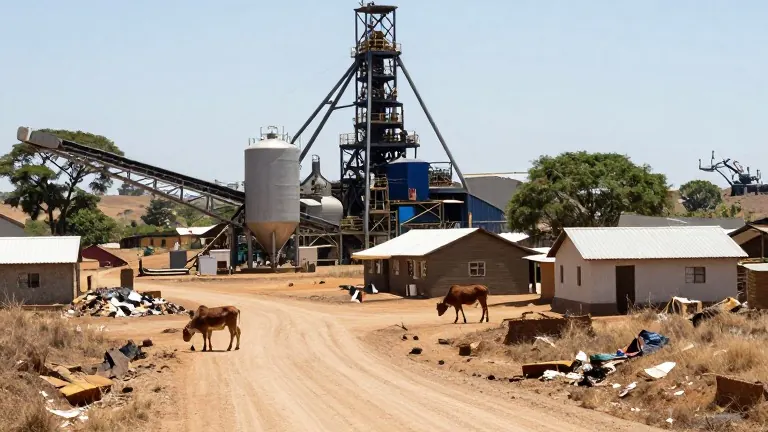
Zimbabwe's platinum industry generated a record $8.5 billion in export earnings in 2025, yet residents in mining communities say the wealth has not translated into better infrastructure. The sector accounts for roughly 75 percent of the country's exports and 14.5 percent of its gross domestic product. Despite this economic weight, local residents in the Mhondoro-Ngezi district argue that basic services such as roads, schools, and water supplies have failed to keep pace with the extraction of resources from beneath their land.
The price of platinum reached an all-time high of $2,923 per ounce on January 26, driven by a broader rally in precious metals and supply concerns, according to the World Platinum Investment Council. John Musekiwa, then-president of the Chamber of Mines of Zimbabwe, attributed the increase in export earnings from $5.9 billion in the previous year to strong output and favorable prices for gold and platinum group metals. Zimbabwe holds the world's second-largest known deposits of these metals after South Africa.
In the Mhondoro-Ngezi district, the Great Dyke geological formation hosts the Zimplats mining complex. While the facility processes ore in modern plants, nearby villages including Turf, Mamina, and Murambwa face infrastructure gaps. Ernest Denhere, headman of Denhere village in Ward 3, requested that mining companies build a road connecting Kadoma and Kwekwe to the Harare-Masvingo highways. He emphasized the need for a lasting legacy from operations in the area.
Educational challenges persist in the region. Ward 3 Councillor Emmah Chikwai noted that children from villages such as Jompani and Makwavarara walk between 15 and 25 kilometers to reach Musinambi Secondary School. She appealed for mines to help establish a satellite secondary school in Makwavarara. At Turf Primary School, pupils were observed learning under trees in September as rising enrollment strained available facilities.
Livelihoods are also affected by the environmental footprint of mining operations. Sakina Lice, a resident of Turf, relies on collecting plastic waste to support her family of 11 children and nine grandchildren. She earns approximately $20 a month reselling the material. "Picking up plastics is the only way I survive," Lice said. She requested that the mine empower women to start projects that support their families.
Water quality is another source of tension. Residents allege that sewage from the mining area has entered the Ngwazani River, which is located about 100 meters from a dump site. Edson Mabure, whose family was relocated due to mining expansion, stated that the river is now flooded with sewage. Agnes Handidikundiona, who crosses the river with her children, said the water is no longer clean for domestic use or gardens. She noted that flooding prevents some children from attending school and called for a footbridge.
Ward 11 Councillor Nhomboka Kurebwa Javangwe said the area's population has grown as mine workers moved in, outstripping available facilities. He noted that local councillors have limited direct access to Zimplats officials, with only the council chairperson authorized to meet with the company. In Shurugwi, Bulle Madzitire, chairman of the Shurugwi Residents Association, called on the Unki Platinum Mine to invest in classroom blocks, water, and roads. Unki reported an average annual community investment of $1.5 million over the past five years, including the construction of 63 boreholes and support for 32 schools.
Zimplats, Mimosa Platinum Mine, and the Mhondoro-Ngezi Rural District Council did not respond to questions about their specific contributions and development plans by the time of publication. Zimplats head of corporate affairs Hama Saburi indicated he would respond but had not done so. Residents in the platinum belt maintain that their demands for better roads, schools, and water services remain straightforward.
Source: Al Jazeera
More Business · Rip-Off Report · Report a business · Got a Story?